Master Cube Notation in 3 Minutes
The universal language that unlocks every tutorial
Learn the 6 essential moves used across cube tutorials and start solving today. 3 min read
Notation is how algorithms are shared worldwide - learn it once, understand any tutorial forever.
Last reviewed: by the Cubzor Editorial Team.
What You'll Learn
- Read and write all 6 basic cube moves (R, U, F, L, D, B)
- Understand prime notation (') for counter-clockwise rotations
- Read and execute algorithm sequences like R U R' U'
- Recognize what each letter means on Rubik's Cube tutorials
- Follow any cube tutorial or guide online with confidence
The Essential Six Moves: R, U, F, L, D, B Explained
These 6 moves are all you need to start solving. Click each to see an interactive demo.
Interactive Demo
Loading interactive cube...
What it does
Turn the right face clockwise 90 degrees, as if you're looking directly at it.
💡 Memory Tip
Think of opening a door toward you - that's the R move!
Try it: Use the cube demo above to practice this move step-by-step!
What Does Prime (') Mean in Rubik's Cube Notation?
Prime means counter-clockwise. It's that simple!
Compare the Moves
💡 Prime = Rewind ⏪ The apostrophe looks like a rewind button!
R
Clockwise
Loading interactive cube...
R'
Counter-clockwise
Loading interactive cube...
Try it: Perform both moves in sequence - they cancel each other out!
Any move can have a prime. Just add an apostrophe (') after the letter: R', U', F', L', D', B'. These moves go in the opposite direction.
Double Moves: The 2 Modifier (R2, U2, F2)
When you see a number 2 after a letter (like R2 or U2), it means turn that face 180 degrees — two quarter turns in the same direction.
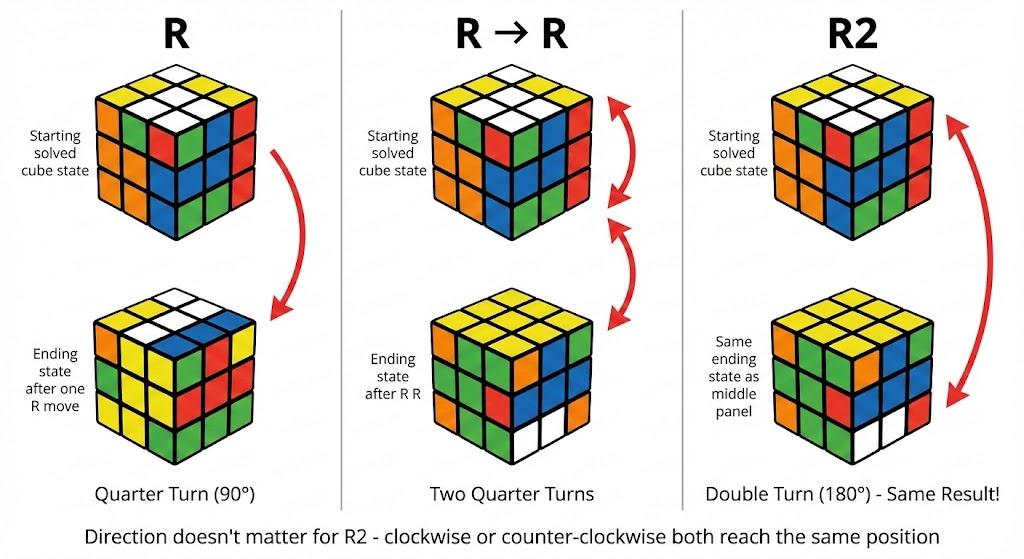
Compare the Moves
💡 R2 = R + R (Do the move twice!)
R
Quarter turn (90°)
Loading interactive cube...
R2
Half turn (180°)
Loading interactive cube...
Try it: Perform both moves in sequence - they cancel each other out!
💡 Important: Direction doesn't matter for double moves! R2 clockwise = R2 counter-clockwise (both are 180°)
Common Double Moves
- R2 = Turn Right face 180 degrees (same as R R)
- U2 = Turn Up face 180 degrees (same as U U)
- F2 = Turn Front face 180 degrees (same as F F)
How to Read Rubik's Cube Algorithm Sequences
Can you read these sequences? Click 'Show Me' to see them performed.
1. R U R' U' — Read left to right - each letter is one move
2. F D F' D' — Remember: Prime (') means counter-clockwise
3. R U' R' U — Mix of clockwise and counter-clockwise moves
Your Cheat Sheet
Your Cheat Sheet
Keep this handy while learning algorithms
Right
Left
Up
Down
Front
Back
📝 Quick Notes:
- •Add ' (prime) for counter-clockwise
- •Add 2 for 180° turns (e.g., R2, U2)
- •Read sequences left to right
Keep this handy while learning algorithms!
Advanced Notation (Optional)
Once you've mastered the basics, explore these advanced techniques used in speedcubing methods like CFOP and Roux.
💡 Skip this for now - come back when you're ready for CFOP or Roux!
Common Questions
Read algorithms from left to right, performing each move in order. R U R' U' means: turn Right clockwise, turn Up clockwise, turn Right counter-clockwise, turn Up counter-clockwise.
Notation is the universal language for sharing Rubik's Cube algorithms. Learning it allows you to understand tutorials, guides, and methods like CFOP or Roux, and share your own solutions.
Start with the 6 basic moves (R, U, F, L, D, B) and prime notation ('). Double moves (R2) appear in most algorithms, so learn those next. Wide moves (r, Rw) and cube rotations (x, y, z) are important for advanced methods like CFOP and Roux.
Face moves (R, U, F) turn only the outer layer. Slice moves (M, E, S) turn only the middle layer. Wide moves (r, u, f) turn two layers together — the outer face plus the adjacent middle layer.
What's Next?
✓ You've mastered notation!
Choose your path: