
3分钟掌握魔方符号
解锁每个教程的通用语言
全球5亿多魔方玩家在使用。学习6个基本转动,今天就开始还原。 3分钟阅读
Notation is how algorithms are shared worldwide - learn it once, understand any tutorial forever.
你将学到什么
- 读写所有6个基本魔方转动(R、U、F、L、D、B)
- 理解撇号符号(')表示逆时针旋转
- 阅读和执行如R U R' U'这样的算法序列
- 识别魔方教程中每个字母的含义
- 自信地跟随任何在线魔方教程或指南
六个基本转动:R、U、F、L、D、B详解
这6个转动是开始还原所需的全部。点击每个查看互动演示。
互动演示
正在加载互动魔方...
它的作用
顺时针旋转右面90度,就像你直接看着它一样。
💡 记忆提示
想象向自己打开一扇门 - 这就是R转动!
试试看: 使用上方魔方演示,一步步练习这个动作。
魔方符号中撇号(')是什么意思?
撇号表示逆时针。就这么简单!
对比动作
💡 撇号 = 倒退 ⏪ 撇号看起来像倒退按钮!
R
顺时针
正在加载互动魔方...
R'
逆时针
正在加载互动魔方...
试试看: 连续执行这两个动作,它们会相互抵消。
任何转动都可以加撇号。只需在字母后添加撇号('):R'、U'、F'、L'、D'、B'。这些转动方向相反。
Double Moves: The 2 Modifier (R2, U2, F2)
When you see a number 2 after a letter (like R2 or U2), it means turn that face 180 degrees — two quarter turns in the same direction.
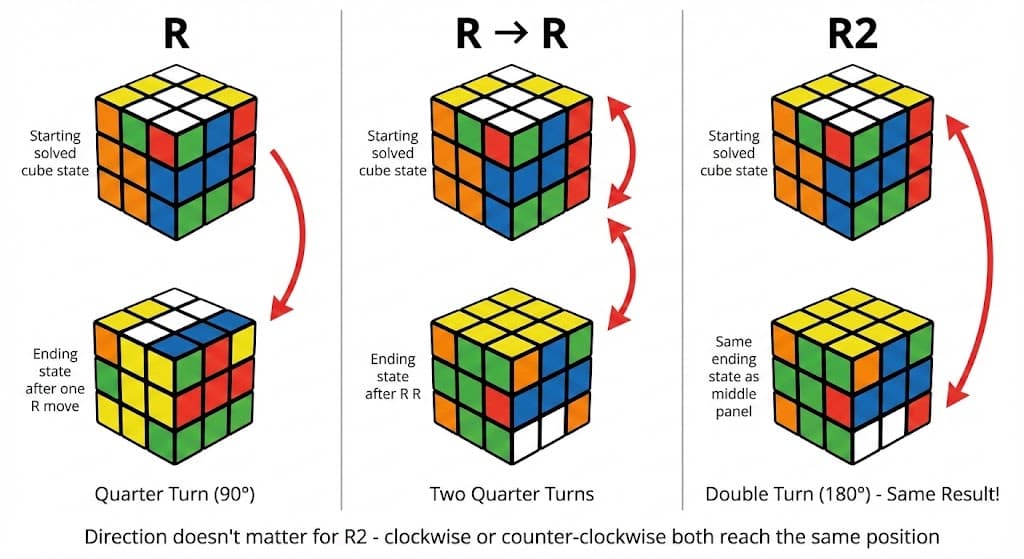
对比动作
💡 R2 = R + R (Do the move twice!)
R
Quarter turn (90°)
正在加载互动魔方...
R2
Half turn (180°)
正在加载互动魔方...
试试看: 连续执行这两个动作,它们会相互抵消。
💡 Important: Direction doesn't matter for double moves! R2 clockwise = R2 counter-clockwise (both are 180°)
Common Double Moves
- R2 = Turn Right face 180 degrees (same as R R)
- U2 = Turn Up face 180 degrees (same as U U)
- F2 = Turn Front face 180 degrees (same as F F)
如何阅读魔方算法序列
你能读懂这些序列吗?点击"演示"查看执行过程。
1. R U R' U' — 从左到右读 - 每个字母是一个转动
2. F D F' D' — 记住:撇号(')表示逆时针
3. R U' R' U — 顺时针和逆时针转动的混合
快速参考卡
快速参考卡
学习算法时随身携带
右
左
上
下
前
后
📝 快速笔记:
- •添加'(撇号)表示逆时针
- •添加2表示180°转动(如R2、U2)
- •从左到右阅读序列
学习公式时可以把它放在手边。
Advanced Notation (Optional)
Once you've mastered the basics, explore these advanced techniques used in speedcubing methods like CFOP and Roux.
💡 Skip this for now - come back when you're ready for CFOP or Roux!
常见问题
Read algorithms from left to right, performing each move in order. R U R' U' means: turn Right clockwise, turn Up clockwise, turn Right counter-clockwise, turn Up counter-clockwise.
Notation is the universal language for sharing Rubik's Cube algorithms. Learning it allows you to understand tutorials, guides, and methods like CFOP or Roux, and share your own solutions.
Start with the 6 basic moves (R, U, F, L, D, B) and prime notation ('). Double moves (R2) appear in most algorithms, so learn those next. Wide moves (r, Rw) and cube rotations (x, y, z) are important for advanced methods like CFOP and Roux.
Face moves (R, U, F) turn only the outer layer. Slice moves (M, E, S) turn only the middle layer. Wide moves (r, u, f) turn two layers together — the outer face plus the adjacent middle layer.
下一步?
✓ 你已掌握符号!
选择你的路径: